
Updated 4 October 2026. This post is from April 2026 and names GPT-4, GPT-4o, Llama 3 as current. The method and the advice still hold; today you would run it with:
- Gemma 4: use these smaller versions for high-speed local tasks where latency is more important than broad reasoning.
- Llama 4 Scout / Maverick: deploy these for structured data extraction and classification tasks on your own hardware.
- DeepSeek V4: use larger, more capable versions for complex reasoning that requires more than a simple local setup.
There is a quiet shift in enterprise AI, and it has nothing to do with bigger models. While headlines chase the next trillion-parameter breakthrough, the companies actually deploying AI at scale are moving toward smaller, task-specific models that run on hardware they own.
Analysts expect this to continue. Gartner predicts that by 2027 organisations will implement small, task-specific AI models with a usage volume at least three times that of general-purpose LLMs (Gartner press release, 9 April 2025). That is a forecast, not a measurement, but it matches the direction of the tooling.
Here is how to think about the choice for your own workloads.
flowchart TD
    A[New AI Task] --> B{Task Complexity?}
    B -->|Routine, repetitive| C[Small Language Model]
    B -->|Complex, novel| D{Data Sensitivity?}
    D -->|Sensitive / GDPR| E[Local LLM]
    D -->|Non-sensitive| F[Cloud LLM API]
    C --> G[Local Hardware]
    E --> G
    F --> H[Cloud Provider]
    G --> I[No per-query fee]
    H --> J[Pay per token]

    style C fill:#059669,color:#fff
    style E fill:#2563EB,color:#fff
    style F fill:#D97706,color:#fff
style G fill:#0D9488,color:#fffWhat Are SLMs and Why Do They Matter?
Small Language Models (SLMs) typically range from 1 to 30 billion parameters. Think Gemma 2 9B, Phi-4, Mistral Small 24B, or Llama 3 8B. They are trained on curated, often domain-specific data and optimized to excel at particular tasks rather than doing everything.
Large Language Models (LLMs) — GPT-4, Claude, Llama 3 70B — have broader knowledge, stronger reasoning, and handle novel or complex queries better. But that generality comes with a cost: compute, latency, and often, a cloud dependency that conflicts with European data sovereignty requirements.
The Cost Reality: Local SLM vs Cloud LLM
This is where the conversation gets concrete:
| Factor | SLM (Local, e.g. Gemma 2 9B) | LLM (Cloud API, e.g. GPT-4o) |
|---|---|---|
| Cost per token | Electricity only, once the hardware is paid for | Per-token price, every month |
| Memory required | A 4-bit 8B to 9B model fits in 8 to 16 GB; a Mac mini M4 is enough | Cloud-hosted |
| Latency | No network round trip | Network round trip plus queueing |
| Data residency | On your premises | Third-party cloud |
| Break-even vs cloud | Depends on your volume | Ongoing expense |
Memory is what separates the classes: at 4-bit, a 70B model needs roughly 40 GB or more, which rules out most desktop machines, while an 8B model runs on almost anything recent. Our GGUF quantization guide shows how to size it.
For the numbers with current API prices, run the script in Cloud vs Local AI: work out your own break-even.
When to Use an SLM vs an LLM: Decision Guide
Not every task needs a 70B model. Not every task can be handled by a 9B one. Here is a starting point:
| Use Case | Recommended | Why |
|---|---|---|
| Customer support triage | SLM | Repetitive, structured, high-volume |
| Document classification | SLM | Pattern matching, domain-specific labels |
| Internal knowledge Q&A | SLM + RAG | Retrieval-augmented, bounded domain |
| Email drafting / templates | SLM | Consistent tone, predictable output |
| Complex legal analysis | LLM | Nuanced reasoning, broad knowledge needed |
| Novel research synthesis | LLM | Cross-domain connections, creativity |
| Code generation (production) | LLM | Accuracy-critical, wide context |
| Data extraction from invoices | SLM | Structured output, high volume, fine-tunable |
The pattern is clear: high-frequency, routine tasks go to SLMs; complex, novel tasks go to LLMs. In our experience, most day-to-day business workloads fall into the first category.
The Hybrid Approach: Best of Both Worlds
The smartest enterprises in 2026 are not choosing one or the other. They are building routing layers that send each query to the right-sized model.
This is the architecture we recommend:
- Incoming request classification — A lightweight model (or simple rules) determines task complexity
- SLM handles routine work — Document processing, classification, templated responses, data extraction
- LLM escalation for edge cases — When the SLM’s confidence drops below a threshold, or the task requires multi-step reasoning, it routes to a cloud LLM
- RAG + fine-tuning bridges the gap — With retrieval-augmented generation and domain fine-tuning, SLMs perform like LLMs for specific verticals
The design goal is that routine queries never leave your hardware, and the ones that do go to a cloud LLM are genuinely the ones that benefit from it. The result: lower running costs, faster responses, and far less personal data crossing to third parties.
Models like Gemma 2 9B, Phi-4, and Mistral Small 24B are good candidates for the local tier. How quickly the hardware pays for itself depends on your query volume. For model benchmarks and recommendations, see our Best Local LLM Models Q2 2026 Comparison.
What This Means for Your Business
The shift toward SLMs is not a technical curiosity — it is a strategic inflection point. Companies that deploy the right-sized model for each task will spend less, move faster, and maintain control over their data.
If you are evaluating AI deployment for your organization, the question is no longer “which LLM should we use?” It is “which tasks can we handle locally, and which genuinely need cloud-scale reasoning?”
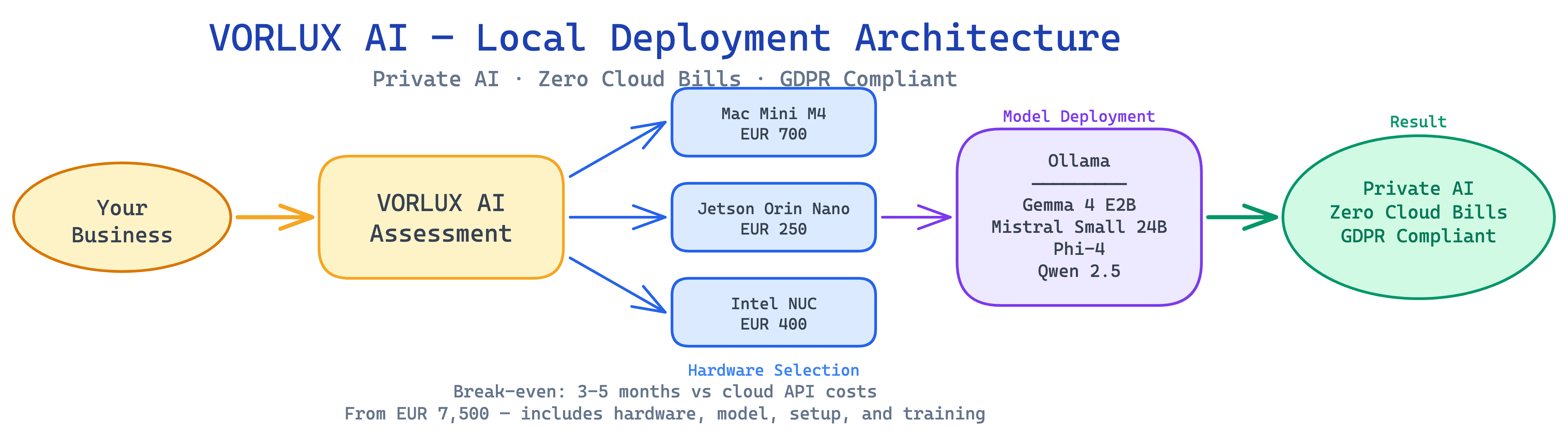
That is exactly the analysis we do at VORLUX AI. We help European businesses map their AI workloads, select the right model size for each task, and deploy locally where it makes sense. Learn more about our Edge AI deployment services.
Ready to find the right model size for your business? Book a free consultation and we will analyze your workloads, estimate your cost savings, and design a hybrid architecture that fits your budget and compliance requirements.
Next steps
- Compare the cost benefits of local SLMs against cloud APIs
- Identify which tasks require a 9B model versus a 70B model
- Review the architecture for building a model routing layer
- Assess the strategic impact of right-sized models on your infrastructure
Related reading
- Best Local LLM Models for Q2 2026: Practical Comparison for SMEs
- AESIA: What Every Spanish Business Deploying AI Must Know in 2026
- AI Evaluations: How to Test Your RAG Pipeline Before Going Live
Work with us
We size the model and the machine by measuring, not by guessing. If you want to see your own task running on real hardware, book a 15-minute call or see how we work in consulting.